
System integration
Firmware must control the real mechanism
A command sent is not a physical result achieved. Sensors, delays, loads and fault responses belong in one system definition.
The practical lesson
Model the physical response
A heater has thermal inertia. A pump can run without delivering the expected flow. A motor can draw current while a mechanism is blocked. Firmware needs observable evidence of the result, not just confirmation that an output was switched on. Sensor location, noise and response time determine what the controller can actually know.
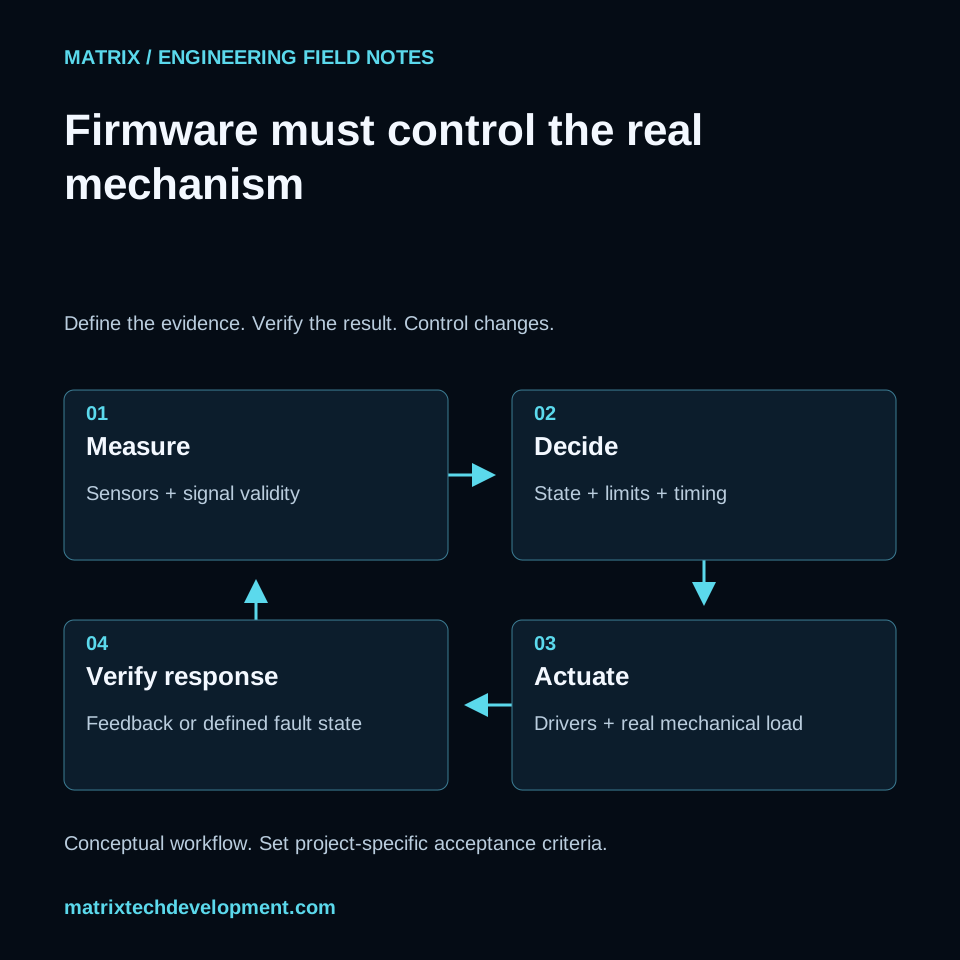
Sensors + signal validity
State + limits + timing
Drivers + real mechanical load
Feedback or defined fault state
Verify the result; control the next change.
Conceptual workflow; project-specific limits and acceptance criteria must be defined.
Define interfaces and fault states together
Agree valid sensor ranges, timing, actuator limits, startup conditions and recovery rules across electronics, firmware and mechanics. Decide what happens on a disconnected sensor, blocked actuator or power interruption. Where risk assessment requires independent protection, implement it in hardware; software cannot compensate for every hardware failure.
Validate on the assembled product
Test representative loads, operating conditions and controlled fault cases. Log sensor values, commands, actual responses and firmware versions together. Set timeouts from measured behavior with justified margins. The UI and app should report the actual state and recovery action, not display success simply because a timer expired.
Questions for your next project review
- Which measurement proves that the commanded action happened?
- What state follows an invalid sensor reading or a timeout?
- Are hardware protection and software recovery tested together?
Short post for sharing
Ready-to-use English copy, with a link to this article.
A command sent is not a physical result achieved. That distinction matters when firmware controls a heater, motor, pump or cooling system. Define the interface around measurable responses, sensor validity, timing and fault states. Then test the complete assembly under representative loads. Matrix-owned programs such as D’Fermenter illustrate why electronics, firmware, mechanics and the user interface must be developed as one system.
https://matrixtechdevelopment.com/insights/integrating-firmware-with-mechanics